
PCB Welding Terminals and Batteries
author: clark
2026-05-18
PCB Welding Terminals and Batteries: The Ultimate Connection Solution for BMS & Inverters
Published on: //www.duanzitai.com
In new energy and industrial power systems, the reliability of electrical connections directly determines the safety, efficiency, and service life of the entire equipment. PCB welding terminals, also known as PCB screw terminals, are core components that securely connect external wires to printed circuit boards (PCBs). As a leading manufacturer specializing in PCB terminal R&D and production, TELIAN (Dongguan Telian Electronics Co., Ltd.) offers over 1,000 models of PCB welding terminals, perfectly compatible with mainstream BMS and inverters on the market. This article will delve into the definition, core parameters, factory strength, and key applications of TELIAN PCB welding terminals in batteries, BMS, and inverters, highlighting their irreplaceable advantages in new energy systems.
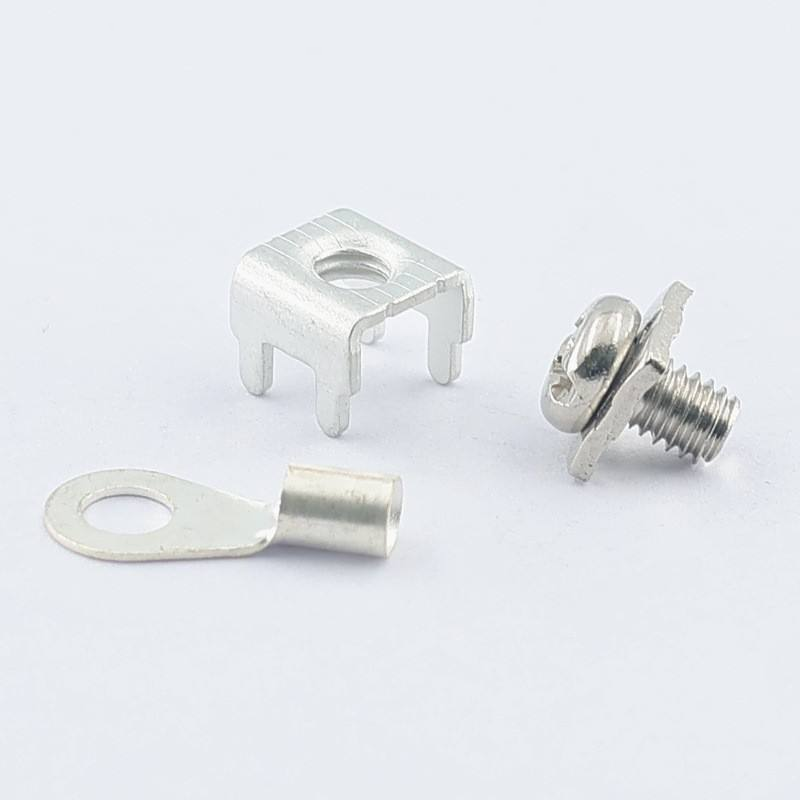
What Are PCB Welding Terminals?
PCB welding terminals (PCB screw terminals) are electromechanical components designed to be soldered directly onto PCBs, providing a stable and reliable interface between external wires and circuit boards. They integrate the functions of electrical conduction, wire fixing, and insulation, serving as a bridge for circuit connection and network integration in electronic devices.
Core Functions
- Securely connect copper wires to PCBs for power and signal transmission.
- Organize complex wiring networks to simplify assembly and maintenance.
- Provide stable electrical continuity, reducing contact resistance and heat generation.
- Insulate and protect circuits to prevent short circuits and electric shock.
Basic Structure
- Conductive part: Made of high‑quality copper alloy (brass/tin‑plated copper) for high conductivity and corrosion resistance.
- Insulating housing: Flame‑retardant engineering plastic (PA66/PBT, UL94 V‑0) for electrical insulation and mechanical protection.
- Screw clamping mechanism: Fix wires tightly to ensure vibration resistance and stable connection.
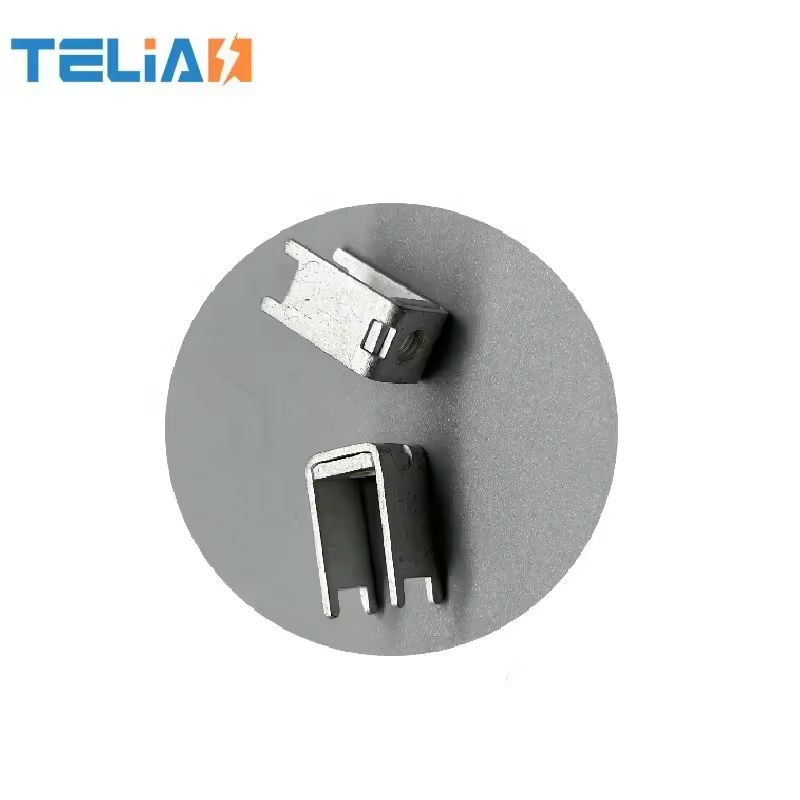
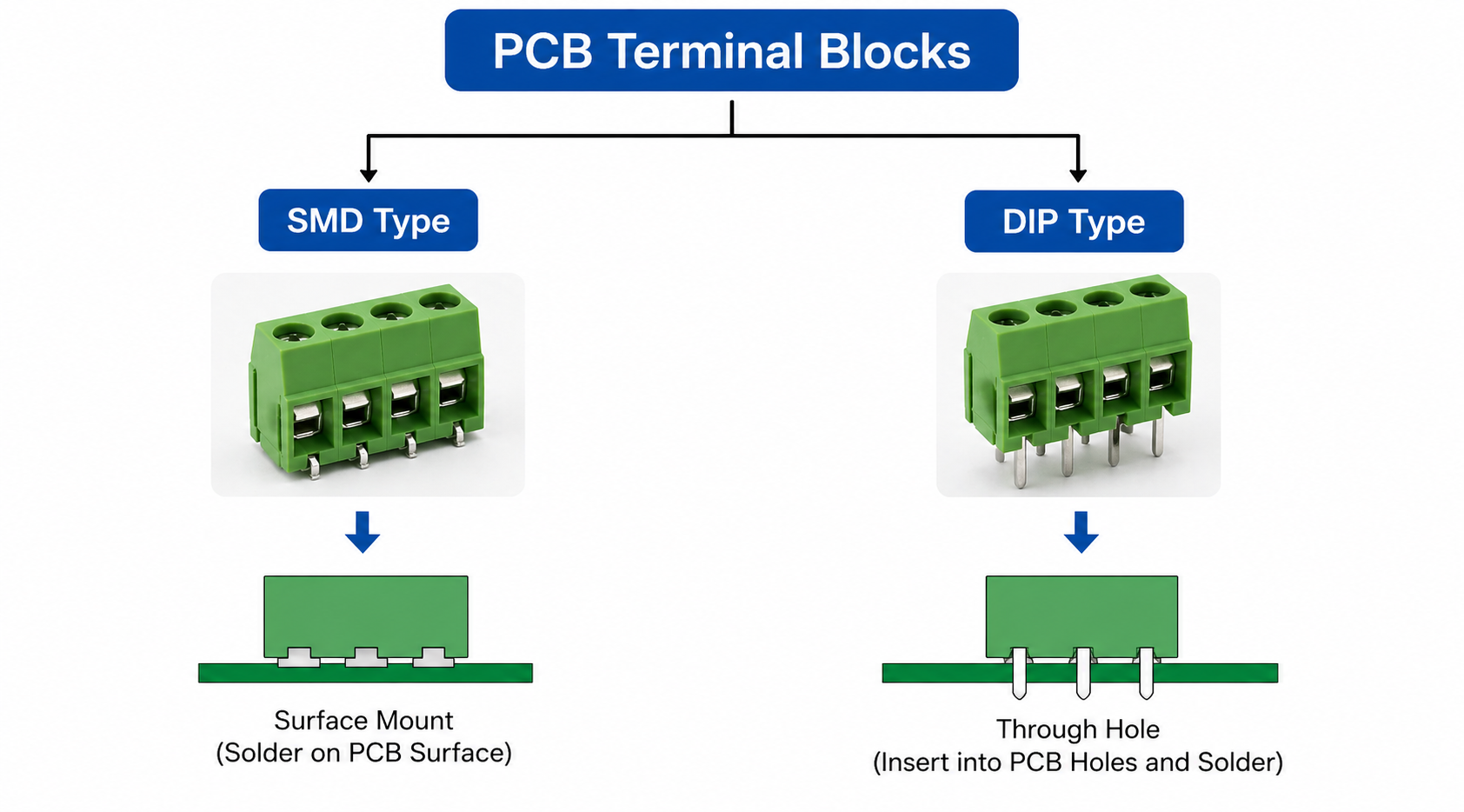
- Welding pins: Soldered to PCB pads, available in through‑hole (DIP) or surface‑mount (SMT) designs.
About TELIAN & Dongguan Telian Electronics Co., Ltd.
Dongguan Telian Electronics Co., Ltd., branded as TELIAN, is a professional terminal manufacturing enterprise with over 20 years of industry experience. Since its establishment in 2002, the company has focused on the R&D, production, and sales of various terminal blocks, becoming a leading supplier in the new energy, energy storage, industrial control, and power equipment sectors.
Our Core Strengths
- Specialization in PCB welding terminals: With 1,000+ models, TELIAN is a professional manufacturer of PCB welding terminals, covering various current specifications, pin counts, and installation methods.
- Strong R&D and customization capabilities: Independent product design, mold development, stamping, injection molding, and automated assembly lines support OEM/ODM customization to meet customers’ personalized needs.
- Wide current range: Products can be manufactured from 20A to 300A, adapting to low‑power signal circuits and high‑power energy storage/inverter systems.
- Strict quality certification: All products comply with UL flame‑retardant certification and RoHS environmental certification, meeting international safety and environmental standards.
- High corrosion resistance: Capable of designing and manufacturing products that pass 72‑hour salt spray testing, suitable for harsh environments such as high humidity and corrosion.
- Advanced production equipment: Equipped with precision testing instruments, mold processing equipment, high‑precision hardware stamping machines, plastic molding machines, and automated assembly lines to ensure product consistency and reliability.
- Wide market recognition: Products are widely used in battery energy storage, photovoltaic inverters, BMS, electric vehicle charging systems, industrial control, and other fields, serving customers worldwide.
Key Technical Parameters of PCB Welding Terminals
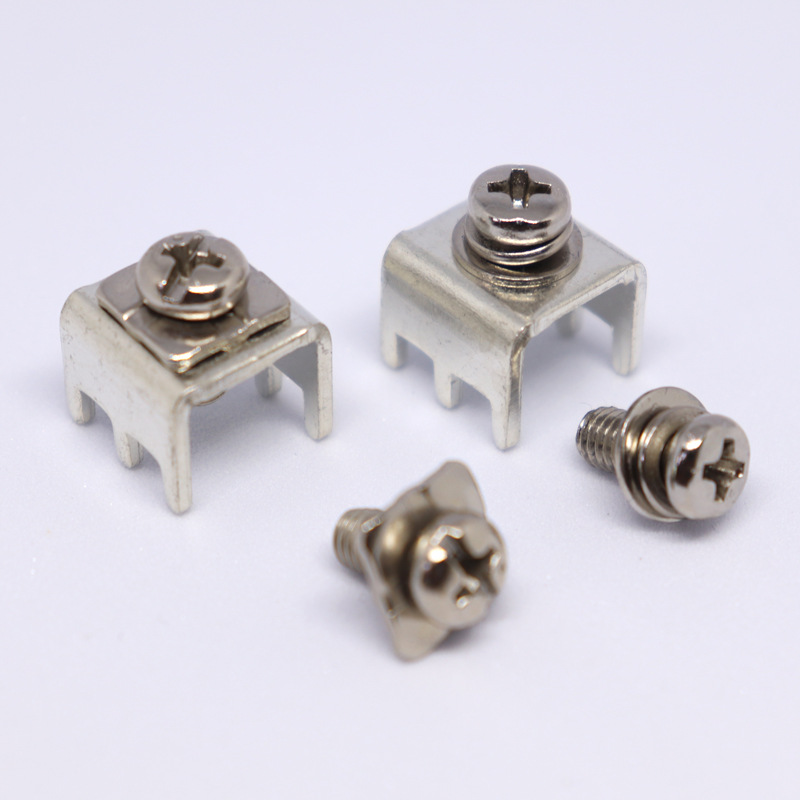
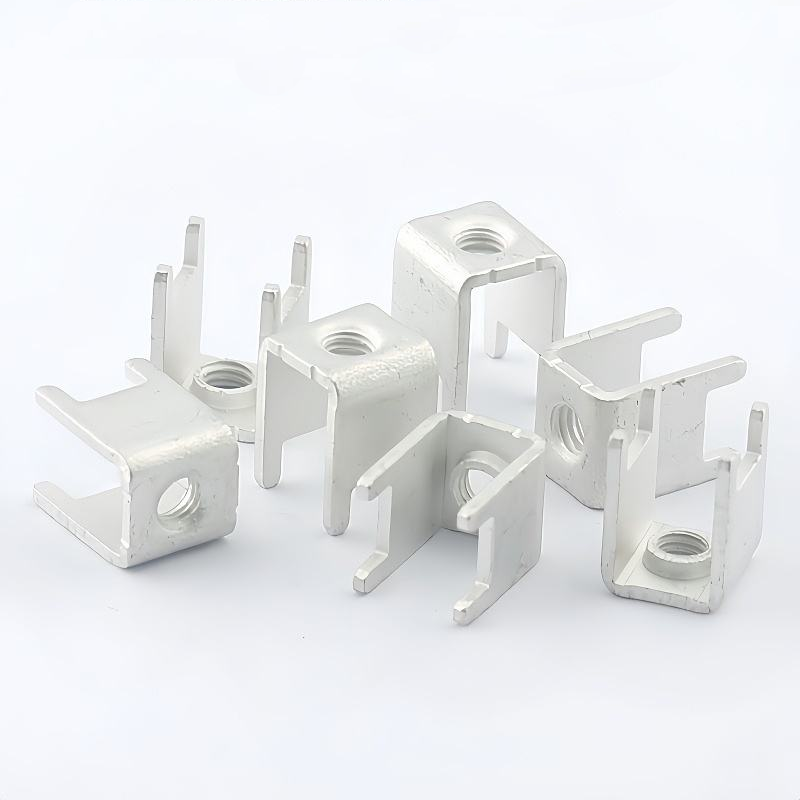
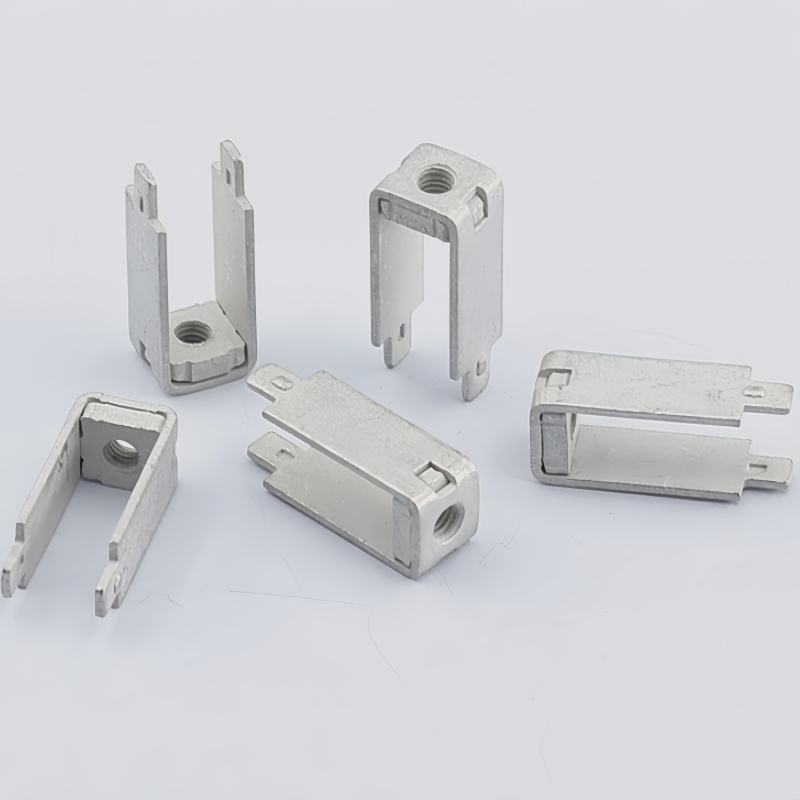
The performance of PCB welding terminals directly affects the stability and safety of the system. The two most critical technical parameters are current carrying capacity and rust resistance.
1. Current Carrying Capacity
Current carrying capacity is the maximum current a terminal can safely conduct for a long time, determined by its conductive material, cross‑sectional area, and heat dissipation design.
- TELIAN’s range: 20A to 300A, covering low‑power control circuits to high‑power energy storage/inverter main circuits.
- Material advantage: High‑purity copper alloy (T2 copper / brass) with low contact resistance and excellent thermal conductivity, reducing heat generation during high‑current operation.
- Application scenarios: 20A–50A for BMS signal and low‑power circuits; 100A–300A for battery main circuits, inverter DC input, and AC output circuits.
2. Rust Resistance (Corrosion Resistance)
Corrosion resistance determines the terminal’s service life and stability in harsh environments (humidity, salt spray, chemical corrosion).
- TELIAN’s capability: Standard products support 24–48‑hour salt spray testing; customized products can reach 72‑hour salt spray testing, meeting high‑corrosion‑resistance requirements.
- Surface treatment: Tin‑plating, nickel‑plating, or silver‑plating on conductive parts to enhance corrosion resistance and conductivity.
- Insulating material: High‑toughness, corrosion‑resistant engineering plastic, resistant to aging and chemical erosion.
Other Important Parameters
- Rated voltage: 300V–1000V, meeting the voltage requirements of batteries and inverters.
- Wire gauge range: 0.5mm²–50mm², adapting to different wire sizes.
- Flame retardancy: UL94 V‑0 level, preventing fire spread in case of overload or short circuit.
- Temperature resistance: -40°C to +105°C, suitable for extreme operating environments.
Battery systems, BMS (Battery Management Systems), and inverters are core components of new energy systems, requiring high stability, low impedance, high safety, and vibration‑resistant connections. TELIAN PCB welding terminals are widely used in these fields with outstanding performance, becoming the preferred connection solution for mainstream BMS and inverter manufacturers.
1. Application in BMS (Battery Management System)
BMS is the “brain” of battery packs, responsible for monitoring battery voltage, current, temperature, and protecting batteries from overcharge, overdischarge, and overcurrent. It requires stable connections between the BMS PCB and battery cells, modules, and external loads.
Typical Applications
- Battery cell voltage sampling: Connect BMS sampling ports to battery cells for real‑time voltage monitoring.
- Temperature sensor connection: Link NTC temperature sensors to BMS for battery temperature detection.
- Power circuit connection: Connect BMS main power (20A–100A) to battery modules and external loads.
- Communication interface: Connect CAN/RS485 communication lines to BMS for data transmission.
- Protection circuit wiring: Connect fuses, relays, and protection components to BMS.
Core Advantages
- High compatibility: 1,000+ models adapt to mainstream BMS designs (2–24 pins, 3.81mm–10.16mm pitch).
- Stable low‑current signal transmission: Low contact resistance ensures accurate sampling of voltage and temperature signals.
- High‑current power support: 20A–300A current range meets BMS main circuit power transmission requirements.
- Vibration resistance: Screw clamping mechanism prevents loosening in electric vehicles, energy storage cabinets, and other vibration environments.
- Compact design: Small size saves PCB space, suitable for compact BMS layouts.
- UL & RoHS certified: Safe and environmentally friendly, meeting global new energy product standards.
2. Application in Inverters (Energy Storage & Photovoltaic Inverters)
Inverters convert DC power from batteries/photovoltaic panels into AC power for grid connection or load power supply, or adjust voltage/frequency for industrial drives. They require reliable connections between the inverter PCB and DC input, AC output, and control signals.
Typical Applications
- DC input connection: Connect battery DC power (100A–300A) to the inverter main circuit.
- AC output connection: Connect inverter AC power (50A–200A) to the grid or loads.
- Control signal wiring: Connect PLC, sensors, and communication lines to the inverter control board.
- Auxiliary circuit connection: Connect cooling fans, relays, and protection components.
- Photovoltaic panel connection: Connect PV panel DC power to the inverter input terminal.
Core Advantages
- High current endurance: 100A–300A high‑current models handle inverter peak loads reliably.
- Low heat generation: High‑quality copper alloy conductive parts minimize power loss and heat generation during high‑current operation.
- Anti‑interference: Stable insulation and isolation reduce electromagnetic interference (EMI) in sensitive control circuits.
- Thermal stability: UL94 V‑0 flame‑retardant materials withstand extreme temperatures (-40°C to +105°C) without deformation or performance loss.
- Easy maintenance: Screw‑type design allows quick wire replacement and maintenance without soldering.
- 72‑hour salt spray resistance: Customized products adapt to harsh environments such as outdoor energy storage and photovoltaic power stations.
3. Application in Battery Systems (Energy Storage & Power Batteries)
Battery systems (lithium‑ion, lead‑acid, etc.) require stable connections between cells, modules, and external circuits. TELIAN PCB welding terminals play a key role in battery PACK and BMS integration.
Typical Applications
- Battery module series/parallel connection: Connect battery modules in series/parallel to form a battery pack.
- Battery PACK internal wiring: Connect BMS, fuses, relays, and other components inside the battery pack.
- Energy storage cabinet internal‑external connection: Connect battery packs to inverters, chargers, and external loads.
- Portable energy storage power supply: Connect battery cells to the main control board and output interface.
Core Advantages
- Safe isolation: Insulating housing prevents short circuits between battery positive and negative poles.
- High current stability: Low contact resistance reduces heat generation during charging/discharging, improving battery efficiency and safety.
- Vibration resistance: Secure clamping prevents loosening in mobile energy storage and electric vehicle environments.
- Modular design: 1,000+ models support flexible combination and expansion, adapting to different battery pack sizes and power requirements.
Why Choose TELIAN PCB Welding Terminals for Batteries & Inverters?
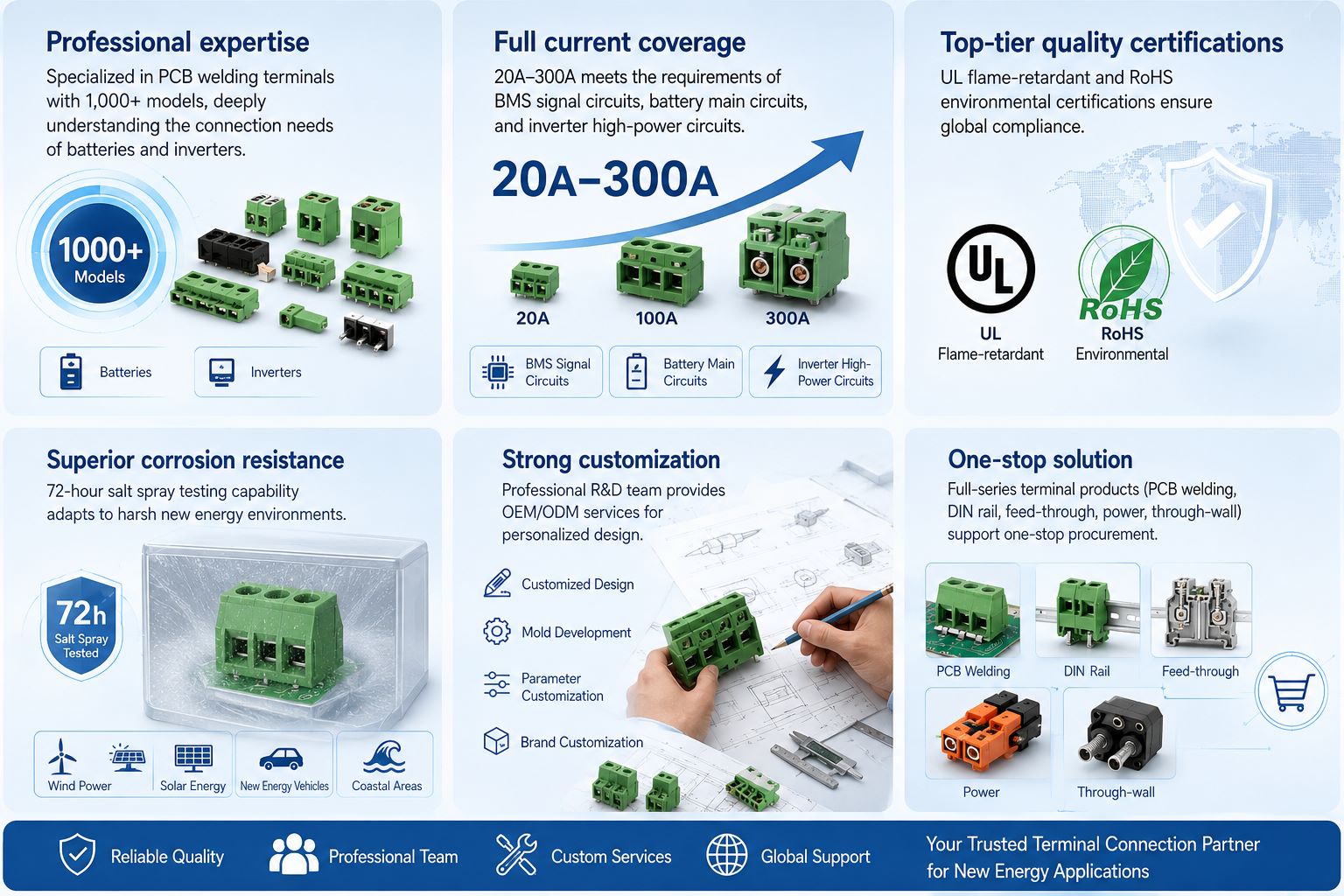
- Professional expertise: Specialized in PCB welding terminals with 1,000+ models, deeply understanding the connection needs of batteries and inverters.
- Full current coverage: 20A–300A meets the requirements of BMS signal circuits, battery main circuits, and inverter high‑power circuits.
- Top‑tier quality certifications: UL flame‑retardant and RoHS environmental certifications ensure global compliance.
- Superior corrosion resistance: 72‑hour salt spray testing capability adapts to harsh new energy environments.
- Strong customization: Professional R&D team provides OEM/ODM services for personalized design.
- One‑stop solution: Full‑series terminal products (PCB welding, DIN rail, feed‑through, power, through‑wall) support one‑stop procurement.
Safety & Application Best Practices
- Match current rating: Do not exceed the terminal’s rated current to avoid overheating, melting, or fire.
- Correct wire gauge: Use wires matching the terminal’s wire range to ensure reliable contact.
- Standardized installation: Solder pins firmly to PCB pads; tighten screws to the specified torque (0.5–0.8N·m).
- Environmental protection: Use UL & RoHS‑certified products to ensure safety and environmental compliance.
- Regular inspection: Periodically check for looseness, discoloration, or damage, especially in high‑vibration environments.
Conclusion
PCB welding terminals are small but critical components that determine the safety, stability, and efficiency of battery, BMS, and inverter systems. As a professional manufacturer specializing in PCB welding terminals, TELIAN (Dongguan Telian Electronics Co., Ltd.) provides 1,000+ models, 20A–300A current range, UL flame‑retardant and RoHS environmental certifications, and 72‑hour salt spray resistance products.
Whether you need standard products or customized OEM/ODM solutions, TELIAN at //www.duanzitai.com supports you with professional R&D, reliable quality, and global service.
For more details about TELIAN PCB welding terminals, product selection guides, application solutions, or custom requests, please visit our official website: //www.duanzitai.com
What is a PCB Welding Terminal
How to Use DIN Rail Terminal Blocks for Industrial Control Batteries Inverters
Related Article
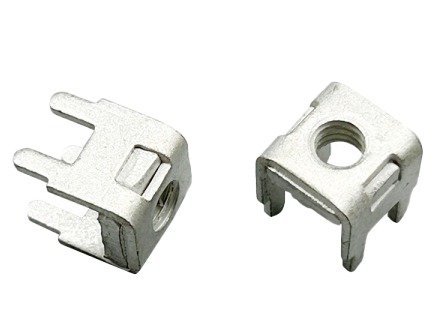
In industrial electrical systems, battery storage, and automotive wiring, connector terminal pins are the unsung backbone of power and signal transmission.
how to remove connector terminal pins
olar and energy storage inverters are the core equipment of the new energy industry, responsible for converting DC power generated by photovoltaic panels and lithium battery packs into usable AC power.
The Indispensable Core Partner of Solar