
What is a Terminal Block in BMS
author: calrk
2026-05-30
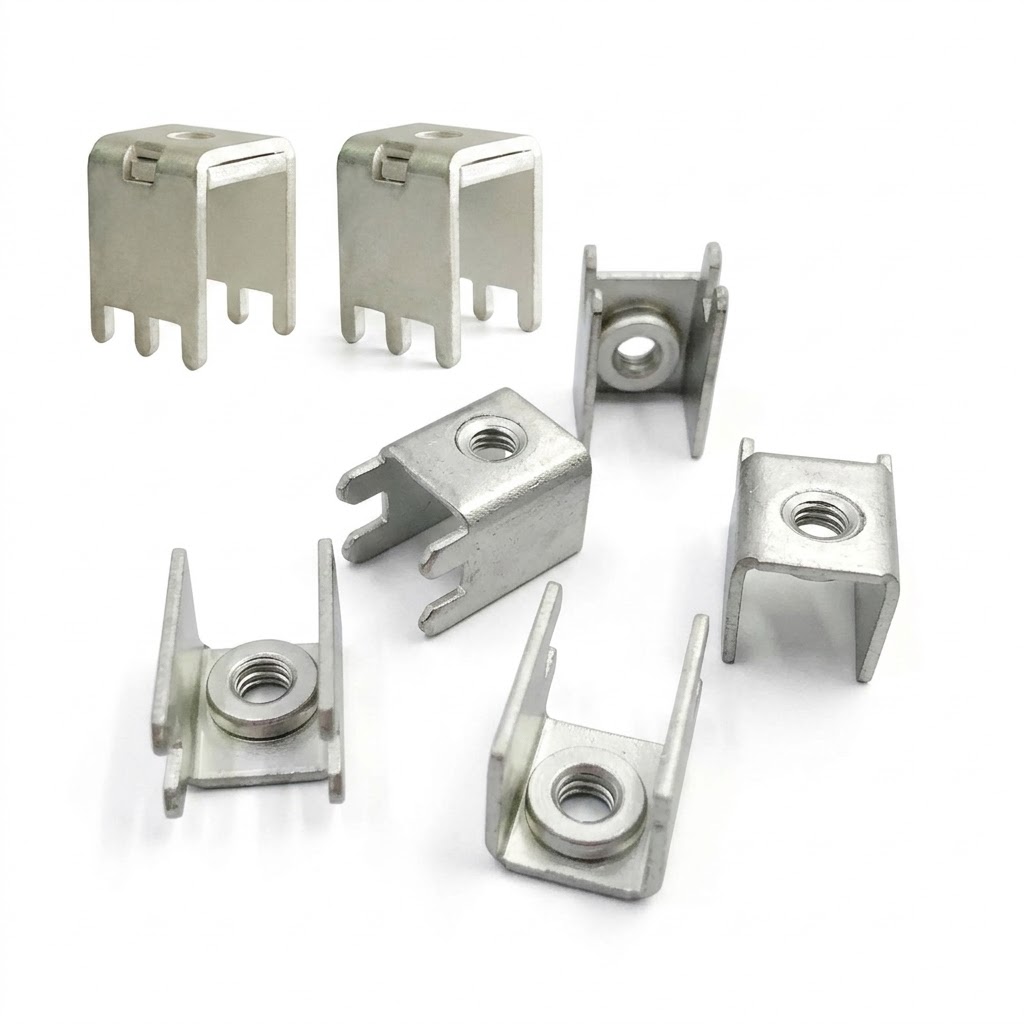
What is a Terminal Block in BMS?
Published on: //www.duanzitai.com
Introduction
In the new energy and energy storage industry, the Battery Management System, widely known as BMS, is recognized as the brain of the battery pack. It undertakes core tasks such as real-time voltage monitoring, current detection, temperature collection, charge and discharge protection, and battery cell balance. The overall performance, service life and operational safety of lithium battery packs, energy storage systems and electric vehicle battery modules all depend entirely on the stability of the BMS. Even minor connection failures inside the BMS may cause signal distortion, system shutdown, or even serious safety accidents such as overheating and short circuits. Therefore, every electronic component and connecting terminal used in BMS must meet ultra-high reliability standards.
Among all key accessories, terminal blocks are the most basic yet indispensable connection components in BMS hardware design. Especially PCB welding terminal blocks have become the mainstream solution for mainstream BMS manufacturers due to their compact structure, stable conduction and strong environmental adaptability. This article will explain what a terminal block is in BMS, its core classification, and focus on the role and unique advantages of TELIAN PCB welding terminals in BMS systems, fully demonstrating TELIAN’s professional strength in the new energy connection field.
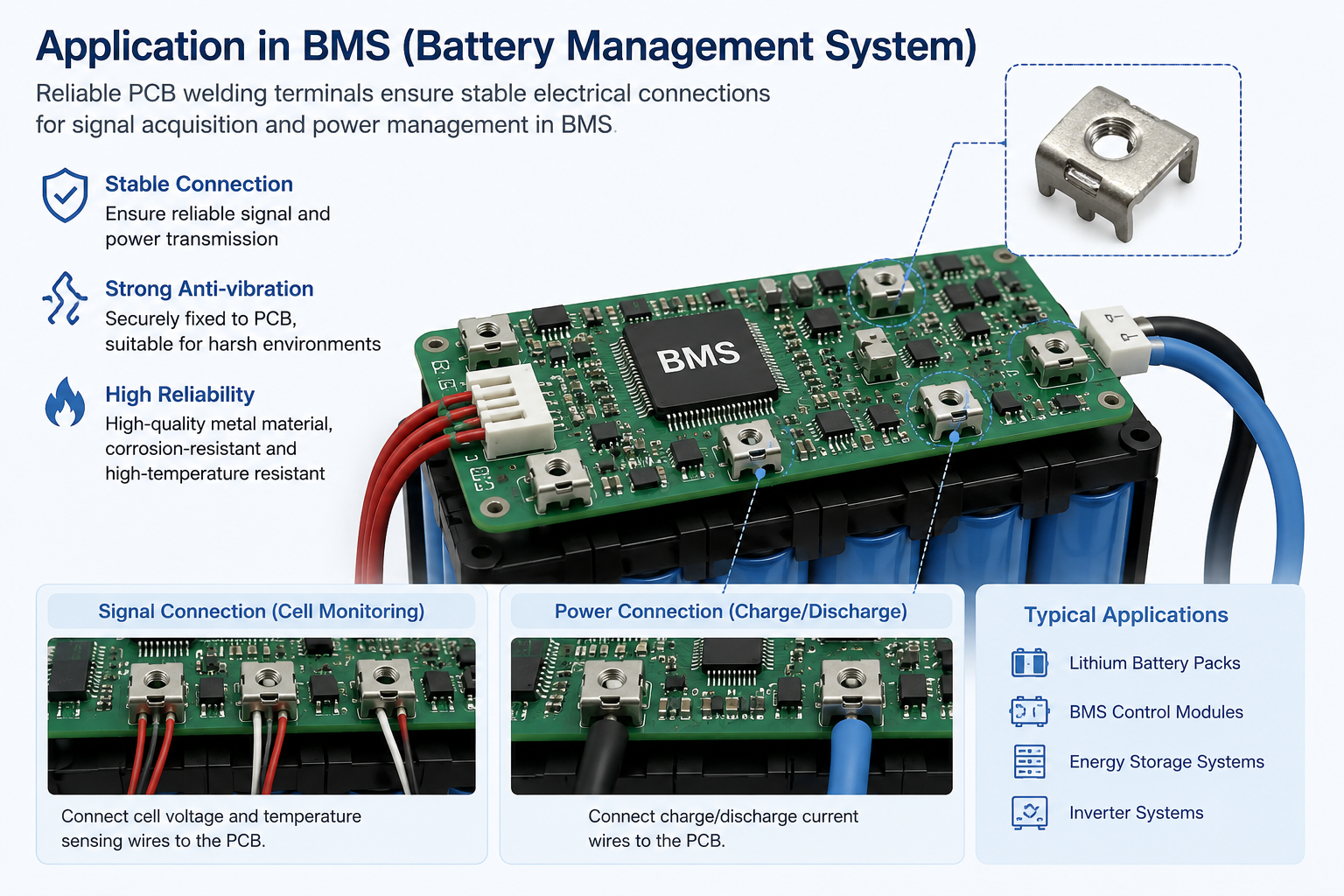
What is a Terminal Block in BMS?
A terminal block in BMS refers to a professional electrical connection component specially designed for battery management systems. It is used to connect battery cells, sampling lines, power lines, temperature sensors and PCB main control boards, forming a complete signal acquisition and power transmission network.
Unlike ordinary terminal blocks used in industrial control, BMS terminal blocks face stricter requirements: long-term high and low temperature cycling, vibration environment, humid air, and high voltage impact. They must maintain stable contact resistance, accurate signal transmission and excellent insulation performance throughout the battery pack’s service life.
Terminal blocks in BMS are mainly divided into PCB welding terminals, plug-in terminals and sampling terminals. Among them, PCB welding terminals are the most widely used. They are directly soldered on the BMS circuit board through DIP through-hole or SMD surface mounting technology, realizing integrated wiring of power and signals, saving board space and improving assembly efficiency.
Why BMS Stability Matters
As the brain of the battery pack, BMS controls every working state of the battery. Unstable BMS operation will directly lead to inaccurate voltage sampling, failed overcharge and overdischarge protection, unbalanced battery cell consistency, and accelerated aging of the entire battery pack. In severe cases, it will trigger battery thermal runaway, fire and other major safety hazards.
The root cause of most BMS failures comes from unreliable wiring connections. Loose terminals, poor corrosion resistance, insufficient voltage withstand capability and excessive contact resistance will gradually cause signal drift and heat accumulation. Therefore, selecting high-quality terminal blocks is the primary guarantee for BMS long-term stable operation. This is also why professional new energy manufacturers choose TELIAN customized PCB welding terminals in batches.
About TELIAN Professional Strength in BMS Terminal Manufacturing
TELIAN, located in Dongguan, is a professional manufacturer focusing on the R&D, design and production of new energy terminal blocks. The company has independent mold development, hardware stamping, plastic injection molding and automated production capabilities, focusing on supporting BMS, energy storage battery packs, inverters and electric vehicle supporting terminal solutions.

TELIAN has always adhered to high-standard manufacturing for BMS dedicated PCB welding terminals, with two core professional indicators leading the industry:
- 48-hour salt spray test certification: The conductive parts adopt high-purity copper alloy and anti-rust surface treatment process, which can pass 48-hour salt spray corrosion test. It maintains stable performance in humid, coastal and harsh chemical environments, effectively preventing terminal oxidation, rust and poor contact.
- 1000V power frequency withstand voltage: The insulating plastic shell has excellent insulation and pressure resistance, supporting 1000V power frequency withstand voltage, avoiding insulation breakdown, creepage and electric leakage risks under high voltage surge, and greatly improving BMS safety.
At the same time, TELIAN’s PCB welding terminals comply with RoHS environmental protection standards, with high flame retardant, high temperature resistant and vibration resistant characteristics, perfectly matching the long-term uninterrupted working requirements of BMS in energy storage, photovoltaic and electric vehicle scenarios.
Core Role of PCB Welding Terminal Blocks in BMS
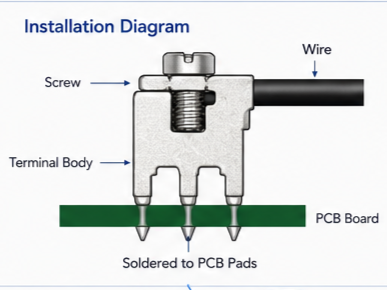
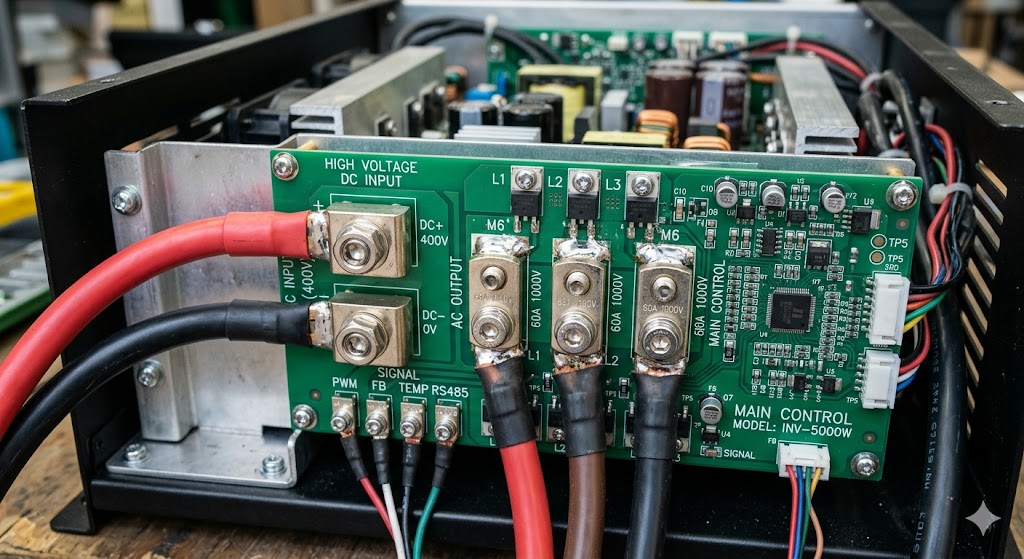
1. Real-time Signal Sampling and Transmission
BMS needs to collect the voltage of each battery cell, temperature data and working current in real time. PCB welding terminals serve as the bridge between sampling lines and PCB boards, ensuring low contact resistance and no signal distortion. Accurate data transmission enables the BMS to accurately judge the battery status and implement precise protection strategies.
2. High-current Power Circuit Connection
In high-power energy storage BMS and electric vehicle BMS, PCB welding terminals undertake the input and output of main current. It can steadily transmit large current for a long time, reduce heat generation, avoid local overheating of the circuit board, and ensure safe charging and discharging of the battery pack.
3. Wiring Integration and Space Optimization
Traditional discrete wiring is messy, difficult to maintain and prone to short circuits. PCB welding terminals are arranged in an orderly manner on the BMS board, standardizing power lines and signal lines, optimizing internal space layout, facilitating automated assembly and later equipment maintenance.
4. Environmental Adaptation and Long-term Anti-aging
Battery packs are often placed in outdoor energy storage cabinets, car bottoms and other complex environments with large temperature differences and high humidity. TELIAN PCB welding terminals pass 48-hour salt spray test and have strong anti-corrosion and anti-aging capabilities, adapting to long-term harsh environment operation and extending BMS service life.
5. Customized Design Compatibility
TELIAN has rich R&D and customization capabilities, which can develop PCB welding terminals of different pitches, pin numbers and current specifications according to BMS design requirements, perfectly adapting to mainstream BMS models on the market.
Conclusion
Terminal blocks are an indispensable core part of BMS. As the brain of the battery pack, BMS’s stability directly determines the safety and service life of the entire energy storage and power battery system. Among them, PCB welding terminal blocks undertake important functions such as signal sampling, high-current transmission and wiring integration, and their performance is crucial.
As a professional terminal manufacturer in Dongguan, TELIAN relies on 48-hour salt spray test performance and 1000V power frequency withstand voltage strength to create high-reliability PCB welding terminals exclusively for BMS. With excellent corrosion resistance, insulation safety, stable conduction and strong environmental adaptability, TELIAN provides reliable connection solutions for global new energy BMS, energy storage battery packs and supporting equipment.
If you want to know more about BMS dedicated terminal block models and customized solutions, please visit our official website://www.duanzitai.com
What is Wire Connector
What is Battery Inverter Connector
Related Article
In industrial electrical systems, battery storage, and automotive wiring, connector terminal pins are the unsung backbone of power and signal transmission.
how to remove connector terminal pins
olar and energy storage inverters are the core equipment of the new energy industry, responsible for converting DC power generated by photovoltaic panels and lithium battery packs into usable AC power.
The Indispensable Core Partner of Solar