
How to Use Terminal Block Connector for Industrial Energy Storage
author: clark
2026-05-09
How to Use Terminal Block Connector: A Complete Guide for Industrial & Energy Storage Applications
Welcome to our professional guide on terminal block connectors—essential components for safe, reliable, and organized electrical connections across industrial control, new energy, energy storage, inverters, and battery systems. At duanzitai.com, we specialize in high-performance terminal solutions engineered for demanding operating environments. This article will walk you through correct usage, classification, core advantages, and key applications of terminal block connectors, with a special focus on Feed‑through Electrical Terminal Blocks and their critical role in batteries and inverters. We will also introduce our brand TELIAN from Dongguan Telian Electronics Co., Ltd., a leading manufacturer dedicated to terminal R&D, production, and global supply.
What Is a Terminal Block Connector?
A terminal block connector (also called a terminal strip or connection terminal) is an insulated elec tro-mechanical component that securely clamps, connects, and distributes two or more electrical conductors. It provides stable electrical continuity, simplifies wiring, protects against short circuits and electric shock, and supports easy installation, maintenance, and replacement.
Modern terminal blocks are widely used in industrial automation, frequency converters, transformers, power supplies, EV charging, BMS, energy storage systems (BESS), rail transit, elevators, and industrial electrical cabinets. High‑quality terminal blocks deliver low contact resistance, high current/voltage endurance, vibration resistance, corrosion resistance, and long service life—all vital for system safety and stability.
About TELIAN & Dongguan Telian Electronics Co., Ltd.
Dongguan Telian Electronics Co., Ltd., branded as TELIAN, is a professional terminal manufacturing enterprise with advanced production technology, independent R&D, mold making, stamping, injection molding, and automated assembly capabilities.
Our strengths:
- Over 2,900 employees supporting large‑scale stable supply
- More than 3,000 terminal block models covering full industrial needs
- In‑house R&D, mold processing, component manufacturing, and final assembly
- Advanced testing and inspection equipment ensuring strict quality control
- High‑precision hardware stamping, plastic molding, and automated assembly lines
- Custom OEM/ODM services for global industrial customers
- Products widely applied in industrial control, frequency converters, transformers, new energy, and energy storage sectors
TELIAN focuses on material toughness, corrosion resistance, and high pressure resistance to provide secure, long‑lasting connections for industrial and energy applications.
TELIAN Terminal Block Product Classification
TELIAN provides a complete terminal block portfolio. Our core lineup includes three major series plus the standard general‑purpose category:
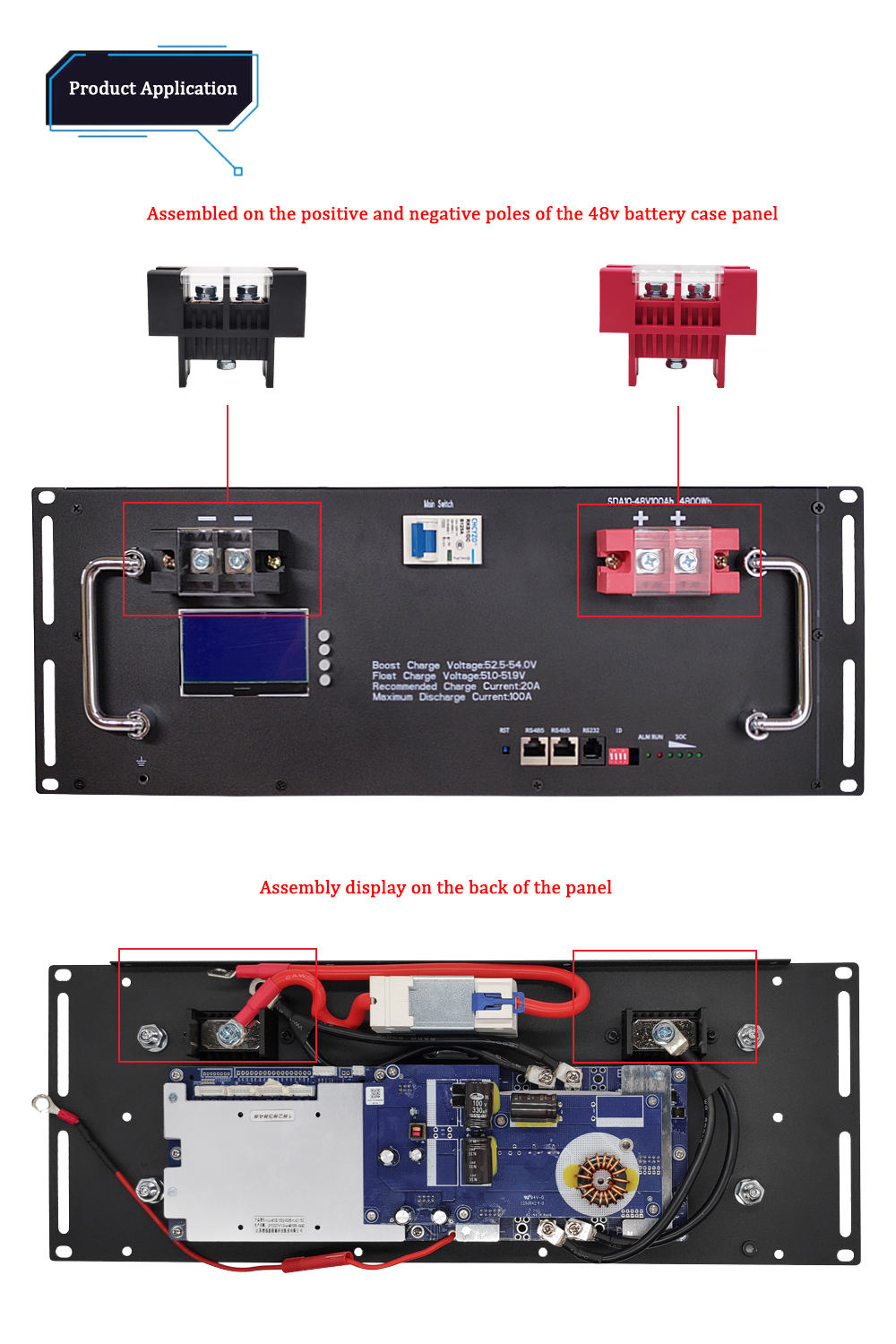
Through‑wall (Panel‑mount) Terminal BlocksIdeal for wiring that penetrates equipment enclosures, cabinets, or panel walls. They separate internal and external circuits while maintaining reliable conductivity, improving sealing and safety.
Power Terminal BlocksDesigned for high current and high voltage conditions. Used in power equipment, inverters, energy storage, industrial drives, and heavy‑duty electrical systems.
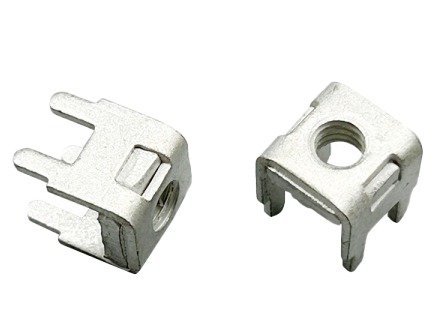
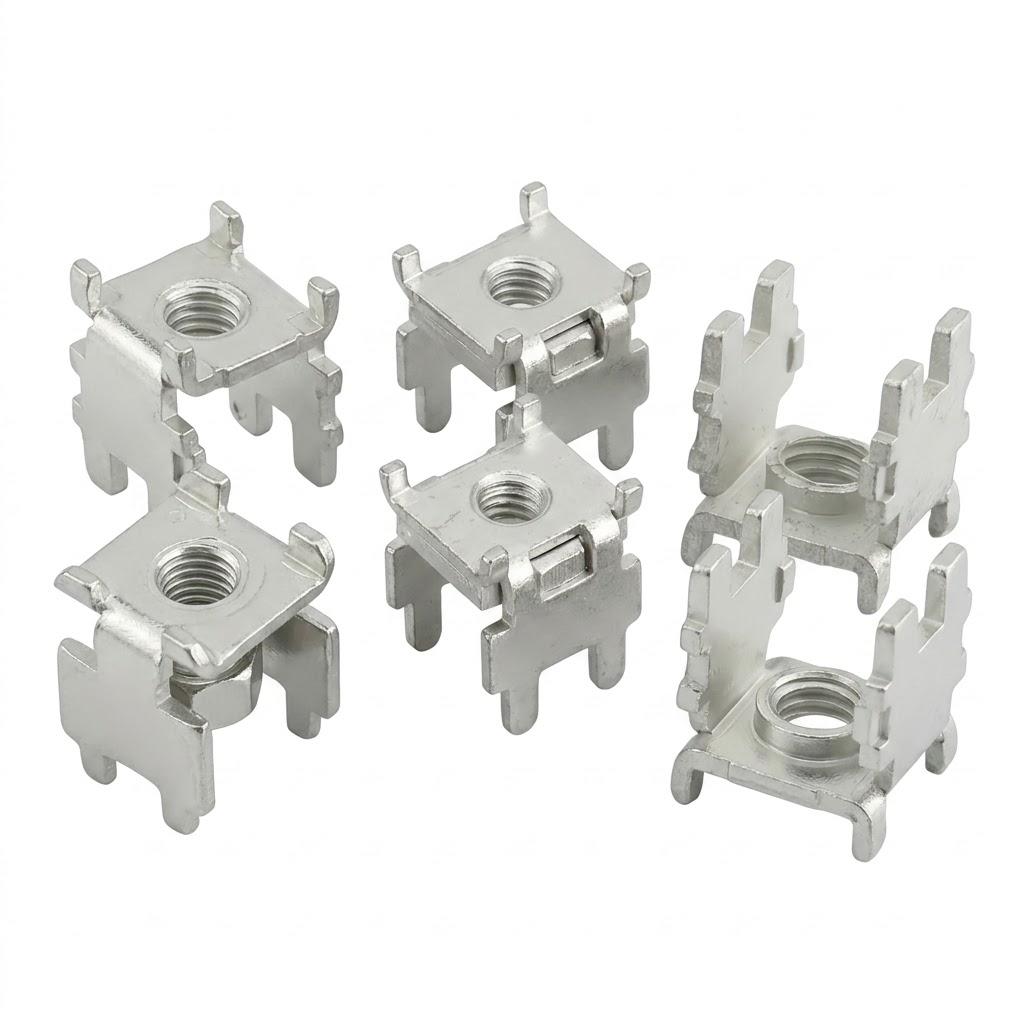
PCB Solder Terminal BlocksSpecially for printed circuit board (PCB) mounting. Supports through‑hole or surface‑mount design, widely used in power supplies, control boards, driver modules, and compact electronic assemblies.
The Standard Universal Type: Feed‑through Electrical Terminal Block
In industrial wiring, Feed‑through Electrical Terminal Block is the most common and versatile category. It serves as the standard general‑purpose terminal for most control and power distribution scenarios.
As the name suggests, feed‑through terminals allow direct pass‑through wiring and modular assembly, typically on DIN rails. They support multi‑circuit centralized wiring, clear identification, easy expansion, and convenient maintenance.
Core Function & Application Scope of Feed‑through Terminal Blocks
Through‑hole terminal blocks (feed‑through type) are suitable for a wide range of scenarios. Their primary function is to connect wires inside and outside enclosures safely and reliably.
Major applications:
- Battery and energy storage industries (BESS)
- Power supply and distribution equipment
- Electric vehicle charging systems
- Battery management systems (BMS)
- Rail transit
- Elevator control systems
- Industrial electrical cabinets and control panels
Feed‑through terminals have become indispensable in energy storage and power conversion systems due to their high stability, ease of installation, and strong compatibility.
Step‑by‑Step Guide: How to Use a Terminal Block Connector Correctly
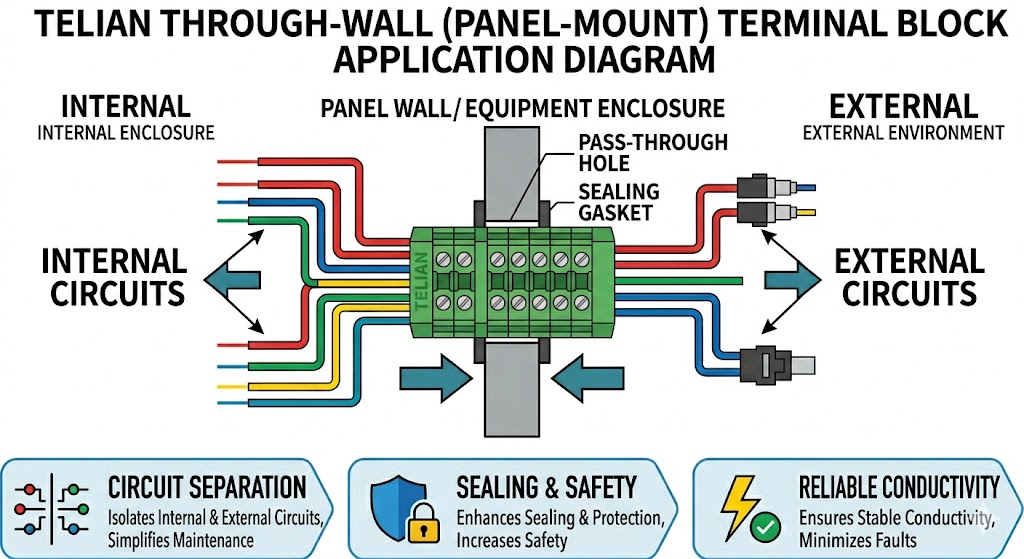
Proper installation directly affects connection reliability, electrical safety, and service life. Below is the standard operating procedure for TELIAN terminal blocks.
Step 1: Preparation & Safety Measures
- Cut off power and verify with a voltage tester before operation.
- Wear insulated gloves, safety goggles, and use insulated tools.
- Prepare wire strippers, crimping tools, screwdrivers, ferrules, and labels.
- Confirm terminal model, rated current/voltage, wire gauge range, and torque specs.
Step 2: Wire Preparation
- Cut wires to proper length with adequate slack for installation and maintenance.
- Strip insulation 5–10 mm (follow TELIAN datasheet) to expose clean copper conductors.
- For stranded wires: twist strands tightly or crimp with a ferrule to prevent fraying.
- Remove burrs or broken strands to avoid short circuits.
Step 3: Select the Correct Terminal Block
Match terminal type to application:
- PCB mounting → PCB Solder Terminal Blocks
- High‑power/high‑current → Power Terminal Blocks
- Cabinet panel penetration → Through‑wall Terminal Blocks
- General DIN‑rail wiring → Feed‑through Electrical Terminal Blocks
Ensure rated current/voltage exceeds system maximum with safety margin.
Step 4: Mount the Terminal Block
- For DIN‑rail terminals: snap securely onto standard TS35 rail.
- For panel/through‑wall types: fix with screws or flange clips to avoid movement.
- Keep terminals aligned and spaced to ensure insulation and heat dissipation.
Step 5: Insert & Secure Wires
- Insert stripped conductor fully into the clamping zone; no strands exposed.
- Tighten screws to specified torque (M3: ~0.5 N·m; M4: ~0.8 N·m).
- Do not over‑tighten (risks wire damage or thread stripping) or under‑tighten (causes loose connection, heat, arcing).
- Use spring‑clamp or push‑in terminals as designed for fast, stable connections.
Step 6: Inspection & Testing
- Visually check: no exposed copper, insulation not clamped, screws intact.
- Gently tug wires to confirm firm retention.
- Use multimeter to check continuity and insulation resistance.
- Label terminals for circuit identification, simplifying future maintenance.
- Clear debris before power‑on; test under load for normal operation.



Key Focus: Feed‑through Electrical Terminal Block
Structure & Working Principle
Feed‑through terminals feature a straight‑through conductive path with insulated barriers between poles. They support screw, spring, or push‑in connections and are modular for easy grouping and expansion.
Core advantages:
- Straightforward pass‑through wiring
- High compatibility with DIN‑rail systems
- Excellent scalability
- Clear circuit isolation
- Easy inspection and maintenance
- Suitable for low‑voltage control and medium‑power circuits
Why Feed‑through Terminals Are Irreplaceable in Industrial & Energy Systems
-
Simplify complex wiringCentralize multi‑circuit connections in cabinets; eliminate messy hand‑twisted joints.
-
Improve system safetyInsulated housing and barrier design prevent short circuits, electric shock, and cross‑talk.
-
Enhance stability & reliabilityHigh‑precision clamping and premium materials ensure stable contact under vibration and temperature cycling.
-
Reduce maintenance costModular design allows quick replacement without rewiring the whole system.
-
Support standardizationUniform dimensions and markings support mass production and consistent assembly.
Conclusion
Terminal block connectors are small but critical components that determine the safety, stability, and durability of electrical systems. Mastering how to use terminal block connectors correctly is essential for engineers, installers, and maintenance teams.
TELIAN from Dongguan Telian Electronics Co., Ltd. provides three core series:
And the standard general‑purpose Feed‑through Electrical Terminal Block, which is widely used in battery, energy storage, power equipment, EV charging, BMS, rail transit, elevators, and industrial cabinets.
Especially in battery and inverter applications, TELIAN Feed‑through Terminal Blocks deliver excellent safety, stability, high current endurance, easy installation, and long service life, making them the preferred connection solution for energy and industrial systems.
Whether you need standard products or customized OEM/ODM solutions, TELIAN at duanzitai.com supports you with professional R&D, reliable quality, and global service.
For more details about TELIAN terminal blocks, product selection guides, application solutions, or custom requests, please visit our official website: //www.duanzitai.com
How to Use DIN Rail Terminal Blocks for Industrial Control Batteries Inverters
Why Use PCB Terminal Block on BMS
Related Article
In industrial electrical systems, battery storage, and automotive wiring, connector terminal pins are the unsung backbone of power and signal transmission.
how to remove connector terminal pins
olar and energy storage inverters are the core equipment of the new energy industry, responsible for converting DC power generated by photovoltaic panels and lithium battery packs into usable AC power.
The Indispensable Core Partner of Solar